Anna Deichler
I work on multimodal machine learning for embodied AI — integrating language, motion, and 3D space in generative models. I am particularly interested in modeling human behavior and transferring it to robots — learning humanoid control from human motion data — towards robots that perceive people and decide how to act in everyday environments.

About
I am a postdoctoral researcher in the Robotics, Perception and Learning division at KTH, in Danica Kragic's group, where I work on perception and decision-making for humanoid robots within the SAInt project.
I completed my PhD from KTH in 2026. My thesis, Spatially Grounded Communication in Embodied Agents: From Gesture Generation to Referential Understanding, developed generative models, datasets, and benchmarks for how embodied agents produce and interpret spatially grounded multimodal signals.
Before the PhD, I studied systems and control at TU Delft (MSc — robotics, reinforcement learning and planning) and mechatronics engineering at BME Budapest. I spent time at the Max Planck Institute for Intelligent Systems in Tübingen, in the Autonomous Motion department, and in industry working on autonomous trams in a Siemens project.
News
-
Started as a postdoctoral researcher.
-
Launched the Referential Gesture Challenge at the 1st HSI Workshop (ECCV 2026).
-
Defended my PhD thesis, Spatially Grounded Communication in Embodied Agents.
-
Co-organizing the Human–Scene Interaction Workshop at ECCV 2026 in Malmö
-
PoseRefer accepted at the Semantics for Reliable Robot Autonomy Workshop at ICRA 2026.
-
MM-Conv benchmark paper accepted at LREC 2026.
-
Look and Tell accepted at the SpaVLE Workshop at NeurIPS 2025.
Publications
Full list on Google Scholar.
Background
Thesis: Spatially Grounded Communication in Embodied Agents: From Gesture Generation to Referential Understanding — machine learning for nonverbal behavior and grounded reference in robots and avatars. Defended June 15, 2026.
thesis details
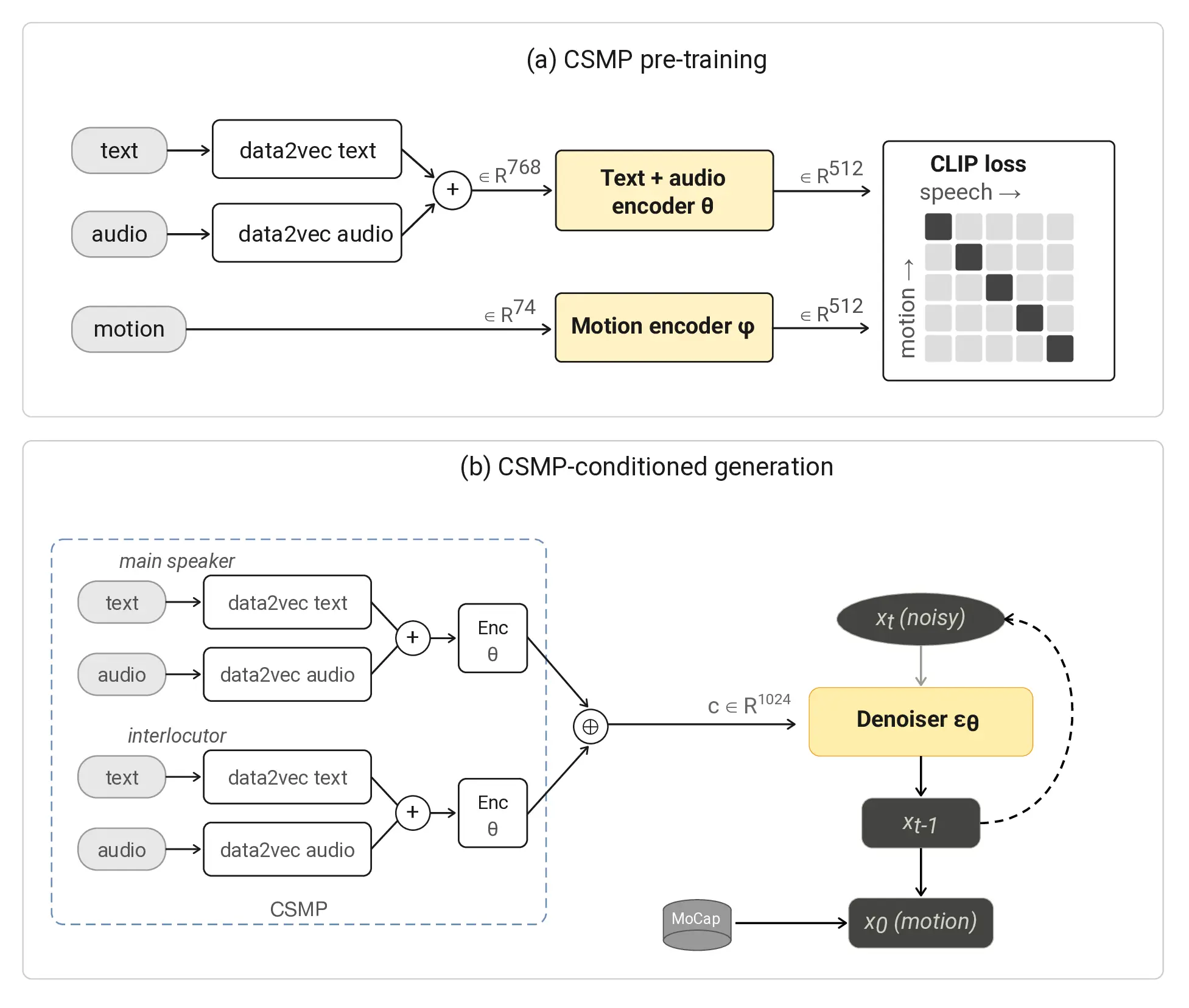
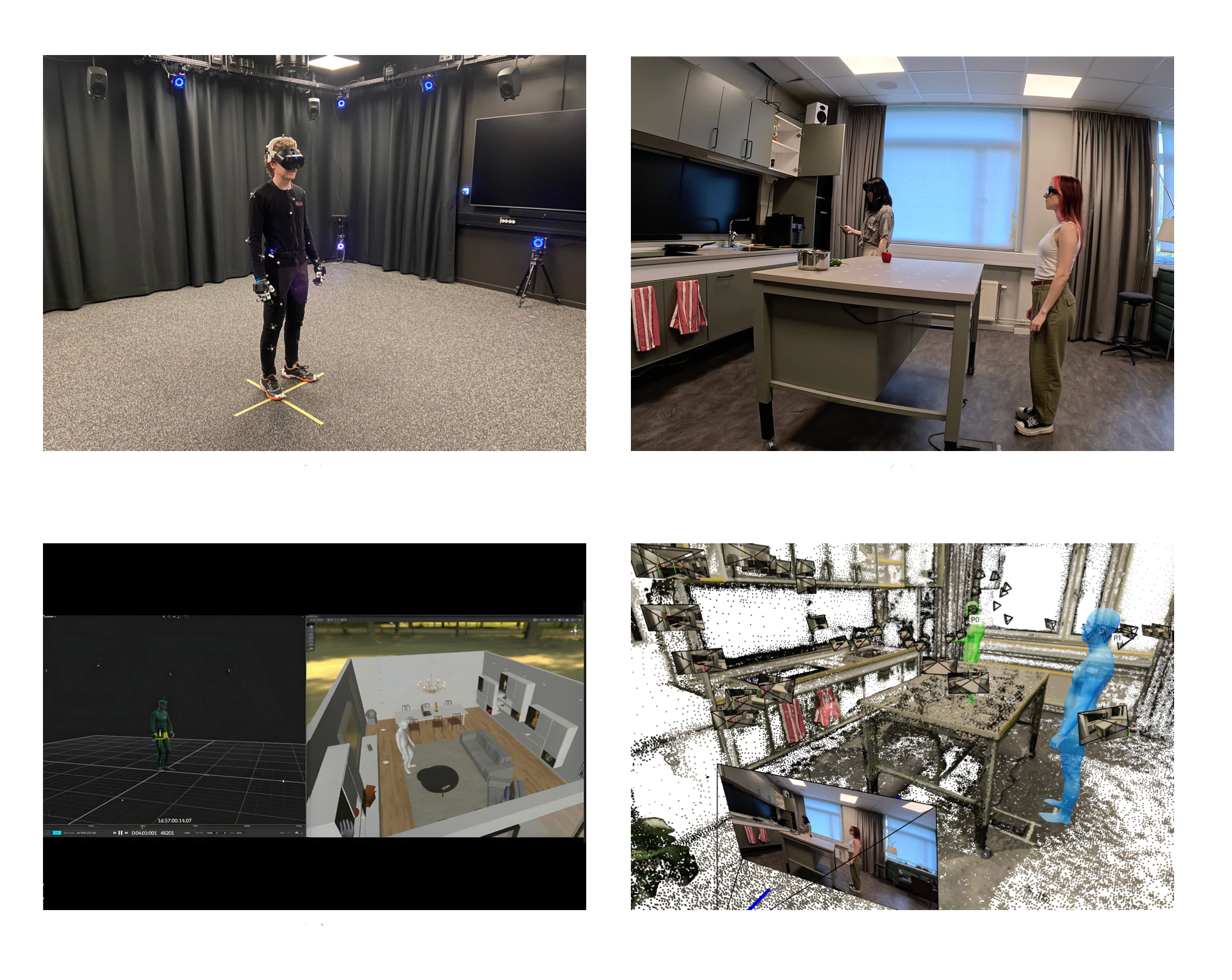
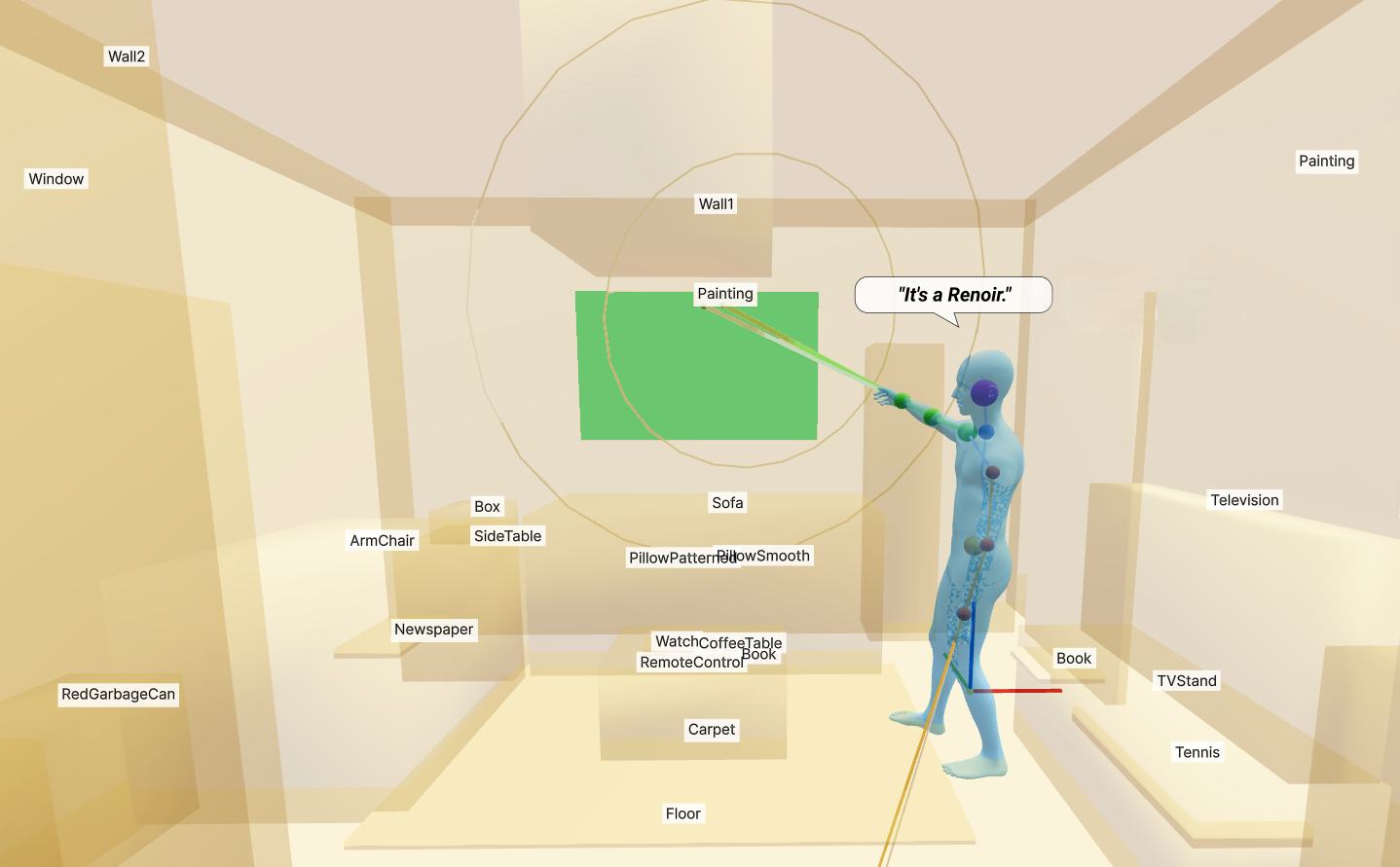
The thesis treats situated communication as two coupled problems — producing spatially grounded nonverbal behavior, and interpreting it. It contributes generative models for co-speech and pointing gesture (CSMP, diffusion; imitation+RL), models and benchmarks for resolving referring expressions against a 3D scene (MM-Conv, PoseRefer), and the datasets underneath — controlled mocap and ego-exo capture with AR glasses.
Core modules in control theory, optimization, and nonlinear system theory; electives in deep learning, computer vision, and AI. Thesis: Generalization and locality in the AlphaZero algorithm.
thesis details
AlphaGo was the first system to reach professional human-level play in Go by combining pattern knowledge from a deep neural network with Monte Carlo tree search (MCTS). MCTS relies on local, dynamic position evaluation — each edge stores its own statistics, making it easy to separate the effect of actions locally — whereas the strength of deep networks is generalization from previous experience to new situations. The pairing echoes the dual-process account of human reasoning: search plays the role of slow, deliberate planning, the network that of fast intuition, and the success of AlphaZero can be seen as the complementary interplay of the two.
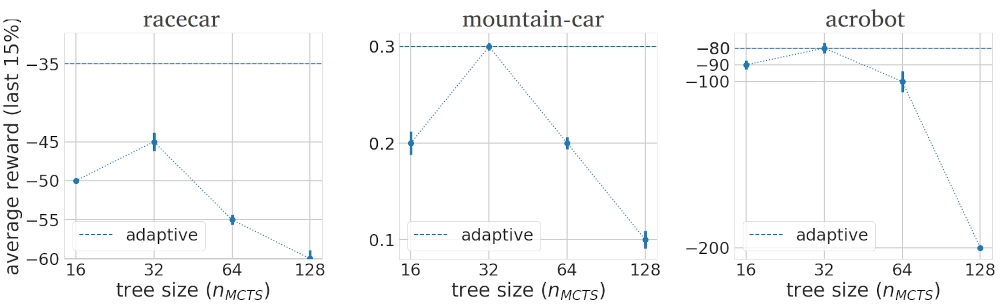
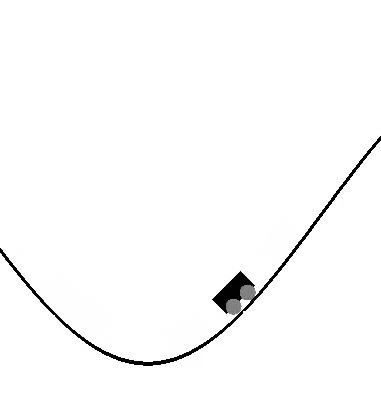
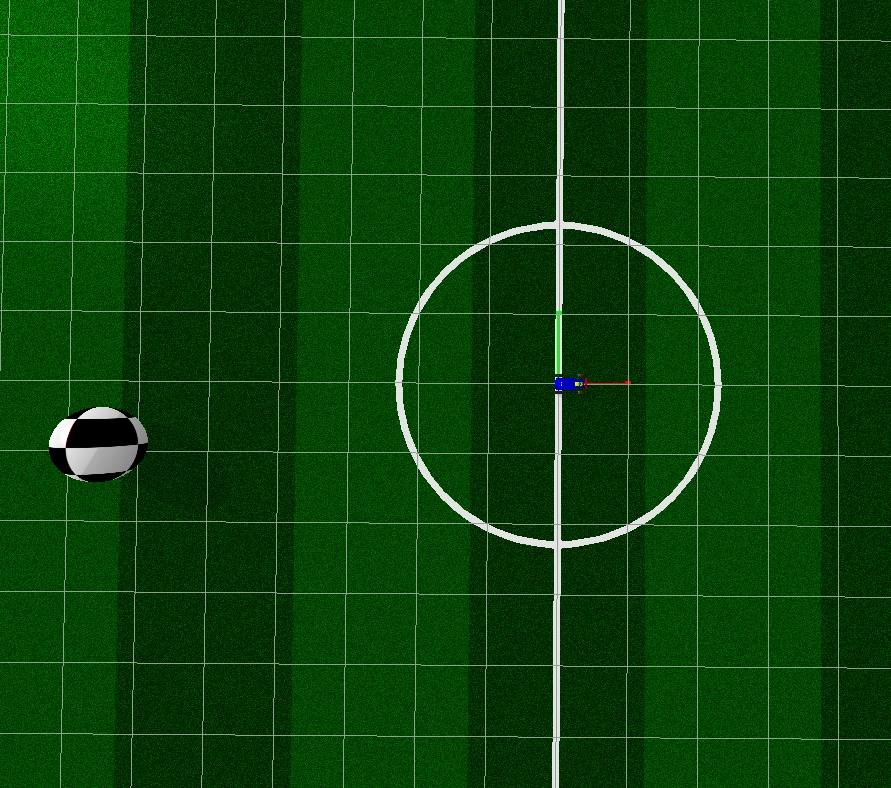
The thesis examined the relative importance of local search versus generalization in AlphaZero in single-player, deterministic, fully observable RL environments (OpenAI Gym, PyBullet). The trade-off was probed by varying the number of MCTS iterations NMCTS per decision step: under a fixed time budget this sets how much effort goes into accurate local values via larger search trees versus improving generalization through more frequent network updates.
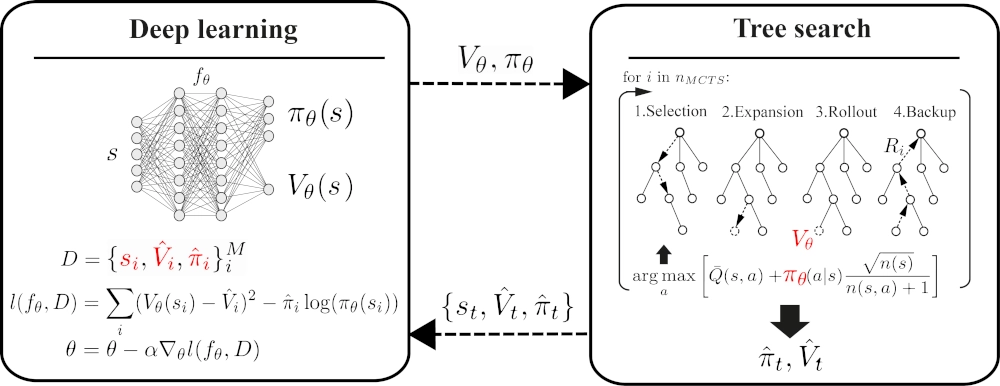
Mid-size trees achieved the best performance for fixed NMCTS. Adaptively choosing NMCTS at each decision step — comparing root return variance against a rolling baseline and running extra iterations when value estimates are uncertain — improved both computational efficiency and final performance.
Core modules in fluid mechanics, multibody dynamics, solid mechanics, vibrations, electrodynamics, and sensor technology. Thesis: The application of generalized hold functions in delayed digital control systems.
thesis details
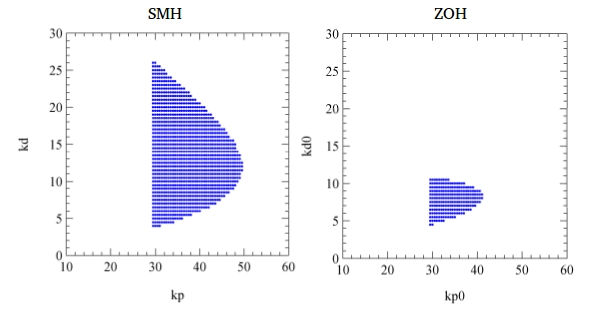
The thesis examined system stability under different hold functions in digital control, with and without time delays, for the classical problem of balancing an inverted pendulum with a discrete-time PD controller. Stability was analyzed for zero-order, first-order, second-order, and system-matched hold (SMH) functions — SMH being a special generalized sampled-data hold derived from the system dynamics — and presented as stability charts in the plane of proportional and derivative gains.
Higher-order hold functions enlarge the stable region in the gain plane, and with SMH the stable region becomes infinite when no time delay is present. Delays significantly shrink the stable region in all cases; the critical (smallest stabilizable) pendulum length was computed for zero-order hold, and higher-order holds were shown to decrease it for a given delay.
More human movement
Danskroki — animating dance croquis sketches with image-to-video models.